Smart Shopping: The Everyday Skill That Turns Children Into Smart Thinkers
Have you ever seen a young child standing in a store, holding two products, and carefully comparing them as though they were making the most important choice of their life? I have, and that experience made me realize how important it is for all kids to learn about smart shopping.
A Classroom Experience That Changed My Opinion
During a Grade 4 "Smart Shopping" class one afternoon, our teacher asked the students to share instances in which they made deliberate purchasing decisions. What followed was unexpected, enjoyable, and, to be honest, wiser than many adult conversations about money.
First, a small boy held up his hand. He smiled proudly and said, "Ma'am, I thought about two options when I needed a new water bottle. One broke easily but was cheaper to buy. The other was more costly, but it was stronger. Because it lasts longer and is still reasonable, I went with the stronger one!"
Another student said, "I told my mom to check other websites before buying my shoes," before we were able to understand that. We saved money because we found the same pair at a better price!
I came to a profound realization that day: when kids understand the basic concepts of smart shopping, they begin applying it in their daily lives rather than just learning about it.
Smart Shopping: What Is Its Meaning?
Buying the cheapest item is not the definition of smart shopping. It also doesn't imply purchasing the most expensive one. To put it simply, smart shopping means:
- Thinking things through before making a purchase
- Consider costs, quality, and quantity
- Prioritize needs over wants
- Avoid buying things just because they appear appealing
- Check reviews and expiration dates
- Don't go over your budget
- Look for the best deal rather than the largest brand
To put it simply, smart shopping = smart thinking + smart spending.
What We Teach: Children's Real-World Use of Financial Skills
1. Needs over Wants
We assist kids in realizing that "needs" are necessities for survival, such as food, medicine, and school supplies. "Wants" are nice to have—fancy stationery, toys, chocolates. This simple clarity helps students avoid impulsive shopping.
2. Comparing Costs and Quality
We show them:
- A big pack vs a small pack
- Two biscuits in different quantities
Children learn that the most costly thing isn't always worth it, and the cheapest product isn't always the best option.
3. Planned vs Impulsive Purchases
We ask children to identify:
- Items they buy on impulse
- Items they purposely (planned) purchase
This enables people to think things through before acting hastily.
4. Verifying Labels and Expiration Dates
When a child proudly exclaims, "Ma'am, I checked the expiration date before buying chips yesterday!" Nothing compares. It's one of the most useful skills they'll have in their lifetime.
5. Understanding Offers & Discounts
We discuss many offers:
- Buy One, Get One Free
- 20% off flat
- Festive discounts
- Online vs offline deals
6. Making a Budget Before Buying
We train students on how to create a little budget:
- Consider how much money they have
- List what they need
- Decide what is affordable
Not everything needs to be spent right now. Some things can wait.
How We Teach: Engaging, Enjoyable, and Useful Learning
Smart shopping is not introduced to children through listening. They pick it up by doing. We use the methods that follow to make this subject interesting and memorable:
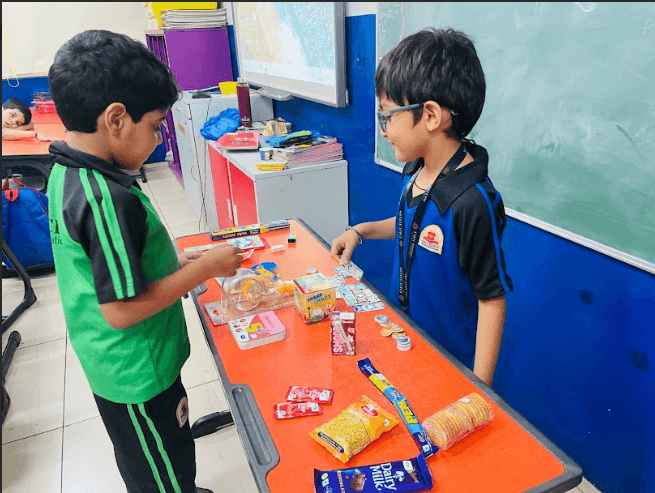
1. Shopkeeper and Customer Role Play
- Children enjoy acting things out
- We opened a small shop with cost tags, fake cash and everyday items
- Students engage in play as the retailer, the client, and the cashier
- They discover: Posing questions, comparing costs, making the right adjustments, making thoughtful decisions
It is one of the most loved activities.
2. Real Products on Display
We bring: Biscuits, snacks, pencils/erasers, water bottles/lunch boxes
Then we allow children to:
- Compare quantity
- Compare MRP
- Look at expiry dates
- Check manufacturing details
Learning becomes real—not theoretical.
3. Interactive Worksheets
We use child-friendly worksheets:
- Differentiate between impulsive and wise purchases
- Select the best option from three options
- Consider the savings
4. Video Education
Children can view the following through brief animated videos:
- How to evaluate products
- Why aren't all discounts useful?
Concepts are remembered when they are learned visually.
5. Storytelling Events
Children adore stories. We employ simple tales such as:
- Riya prefer healthy snacks to unhealthy meals
- Arjun comparing the costs of toys
The Benefits of Smart Shopping for Students
Buying is only one part of smart shopping. It's about building life skills. What children get is as follows:
1. Better Decision-Making
They acquire the ability to reason before making a decision.
2. Improving Math Skills
Comparing prices, calculating discounts, and managing budgets enhance mathematical abilities.
3. Improved Self-Control
Children learn to state:
- "I don't need this right now."
- "I can't afford this."
- "This is out of my budget."
A rare skill, even in adults.
4. Money Awareness
They are aware of the worth of money and the work needed to earn it.
5. Budgeting Skills
They begin to understand budgeting as early as age 8 or 9.
6. Consumer Awareness
As they develop, they become:
- Check the expiry dates
- Examine labels
- Steer clear of frauds
- Compare costs
- Avoid being duped by flashy marketing
This is functional education at its best.
Actual Narratives from Our Classrooms
Here are a few touching examples from our teachers that highlight the significance of this subject:
Story 1: The Comparison of Water Bottles
With pride, a student described how he compared two water bottles: One was weaker yet less expensive. One was strong but a little more expensive. He went with the higher-quality option that fit his budget. That's wise shopping.
Story 2: The Discount Finder Online
"Mum, check on other websites too," a different child said to his mother. Hopefully we'll receive a larger discount. He saved money for the family, made a deal, and felt happy.
Story 3: The Choice to "Avoid Chocolate Today"
A child pointed out a chocolate at the billing counter while they were supermarket shopping. "It's not on my list," he stated after pausing to recall the lesson. I don't need it. His mom was taken by surprise.
Story 4: The Inspector of Expiration Dates
"Ma'am, I checked the expiration date on the chips packet," a student said. It was outdated. I choose a different one! A small step shows a great deal of awareness.
Start Your Child's Financial Journey Today!
Join our Financial Literacy program and empower your child with essential money management skills. From saving habits to entrepreneurship, we're building the next generation of financially smart leaders.