How Coding Helps Students Improve Logical Thinking and Problem-Solving Skills
How Coding Helps Students Improve Logical Thinking and Problem-Solving Skills
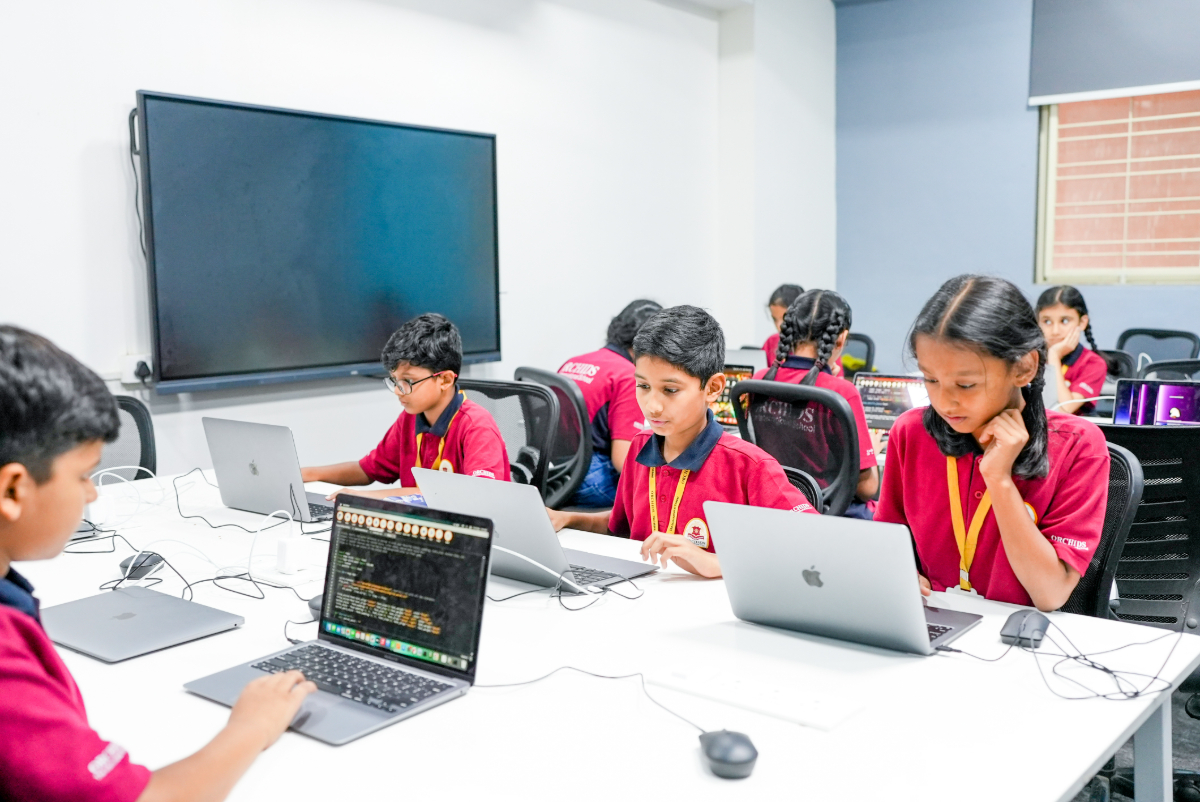
In today’s digital world, children interact with technology every day. But beyond using devices, students need to understand how technology works and how problems are solved using it. This is where coding plays a powerful role.
Coding is not just about learning a programming language. It is about learning how to think logically, analyse situations, and solve problems step by step. These skills support students not only in academics but also in real-life situations.
Understanding Logical Thinking and Problem-Solving
In today’s rapidly changing, technological world, logical thinking and problem-solving are important are the most important skills. Coding gives an opportunity for hands-on learning experience to develop these skills, especially for the young learners.
Coding Trains the Brain to Think Logically
Logical thinking means understanding a problem, organising thoughts, and finding a clear path to a solution. Coding naturally develops this skill because computers work strictly on logic.
When students write code, they must:
Decide the correct sequence of steps
Predict what will happen if a condition is true or false
Understand cause and effect
Even a small program requires clear thinking. If the logic is incorrect, the output will also be incorrect. This trains students to think before they act, improving reasoning and decision-making abilities.
Disintegrating Bigger tasks into Smaller problems
One of the most important skills that develops because of coding is Deconstructing/ disintegrating. In code, every line of code adds meaning to the next line of code. When these lines of code are compiled together, they create a task, a solution. Any problem is broken down into smaller tasks and then solved accordingly.
For example, when students create a project, they follow the steps mentioned below:
Understand the problem
Break the problem into smaller tasks
Solve all the tasks
Integrate the different tasks to get the final product.
These steps of problem solving enable students to identify, understand, disintegrate, solve and then integrate back to get the final output.
Learning Through Trial, Error, and Debugging
In coding, one attempts all possible logical solutions to solve a task and develops the necessary identification and problem-solving skills accordingly. Whenever a problem arises, the logic may be changed slightly, or the entire block of code may need to be replaced according to the requirements. While doing this, students understand the meaning of debugging in coding.
Identify the problem that occurred.
Understand why it happened
Try a different logic, check
If it works, solved, if not, try another logic
Debugging is the process that develops patience, problem-solving, logical thinking and makes us find bugs in a code and develop the skills to solve them with confidence.
Encouraging Analytical and Critical Thinking
Coding requires critical thinking and analytical skills to solve the bugs that occur in the code. For analysing the root cause of the bug, critical thinking on finding the most feasible solution that is compatible with the complete code.
These analytical skills strengthen students’ ability to evaluate situations, predict outcomes, and choose the best solution, in real-life scenarios.
Enhancing Creativity Along with Logic
Coding something doesn’t mean creating something that is just logically correct, it should be something that is also creative or has improved from the previous version. In Orchids - The International school, we teach students how to combine logic and creativity to get visually good and logically correct project.
Design frontend
Apply logic to make the frontend function
Combine backend and frontend to get the final project.
Students in Orchids - The International school are working on creation of animation, games, application by analysing the code and making modification as per their creativity.
Improving Focus and Attention to Detail
Coding requires focus on precision. Any random logic cannot serve the purpose of the proper functioning of the project. In Orchids - The International School, students understand the python concepts, accommodate the details and then create their projects according to their imagination.
Learn python logic
Understand the requirement of the project
Integrate specific modules with the python logic to create project.
In doing the above steps, students develop focus to work on one thing at a time. This developed focus and attention heps them to
Building Confidence Through Problem Solving
How do we, in Orchids - The International school develop confidence in coding?
In Orchids - The International school coding curriculum, students from grades 4 to 10, learn Core Python basics, then they solve coding tasks for each concept. Once cleared with concepts and their applications, students are introduced to grade specific module. Each module creation is either an animation, a game or an application. During the creation of the project, each step includes challenges/tasks to be solved. With solving of each task, students understand what was the error or missing part of the code and they solve it to complete the code and get the required output.
Solving tasks on their own boosts self-confidence and encourages students to take on more complex challenges with a positive mindset.
Schools Like Orchids The International School Encourage Coding
In today’s world, when technology is developing at such a fast pace, coding is not just a skill, but it has become a necessity to help students develop a problem-solving mindset that stays with them throughout life and keep them up with the advancing world. It develops the skill on how to think instead of what to think.
By teaching students Coding at Orchids The International school we are developing:
Logical orchidians
Problem-solving confident individuals
Independent future ready generation
Orchids The International School coding curriculum focuses to develop students or a generations of coders who not only understand the logic or problem solving but also relate the logics with STEM learning. Combine the coding logics in the movement or working of bots made in robotics, combine logics while working on 3D printing in DIY, use those logics to make a combined project with Horticulture, DIY, Robotics and make it ready to be used in market for applying the knowledge of Financial Literacy.
Conclusion
Orchids The International School is creating a generation with the skills that last a lifetime and can be applied in all scenarios to get the best results with patience, skills, logic, confidence and analytical skills.
When students learn to code, they learn to think—and that is a skill that lasts a lifetime.