Intruder Alert! A Visitor from Beyond Our Solar System
Have you ever heard of comets? The night sky is a host to many amazing celestial bodies in the universe. From old globular clusters to enormous galaxies, the sky can show you a variety of objects with your naked eye, or using a telescope! One of these amazing objects is a Comet.
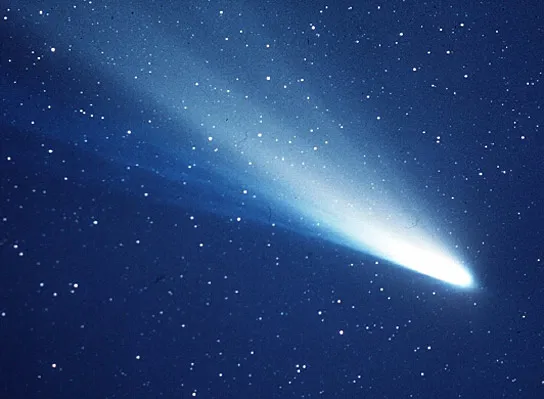
Halley’s Comet
Photo Credits: NASA
The Wandering Snowballs of Space
Comets are often called the wandering snowballs of space, made of ice, dust, rock, and frozen gases. They mostly exist in the coldest, farthest regions of our solar system, such as the Kuiper Belt and the Oort Cloud. For most of their lives, they stay frozen and quiet. But sometimes, gravity from nearby stars or planets nudges them off their path and sends them on a long journey toward the Sun, beginning an exciting transformation.
As a comet approaches the Sun, it begins to warm up. The heat causes the ice on its surface to melt and turn directly into gas, releasing dust in the process. This forms a glowing cloud called the coma around the nucleus. Solar radiation and solar wind then push this gas and dust outward, creating a spectacular tail. What’s fascinating is that the tail always points away from the Sun, no matter which direction the comet is moving, due to the force of the solar wind.
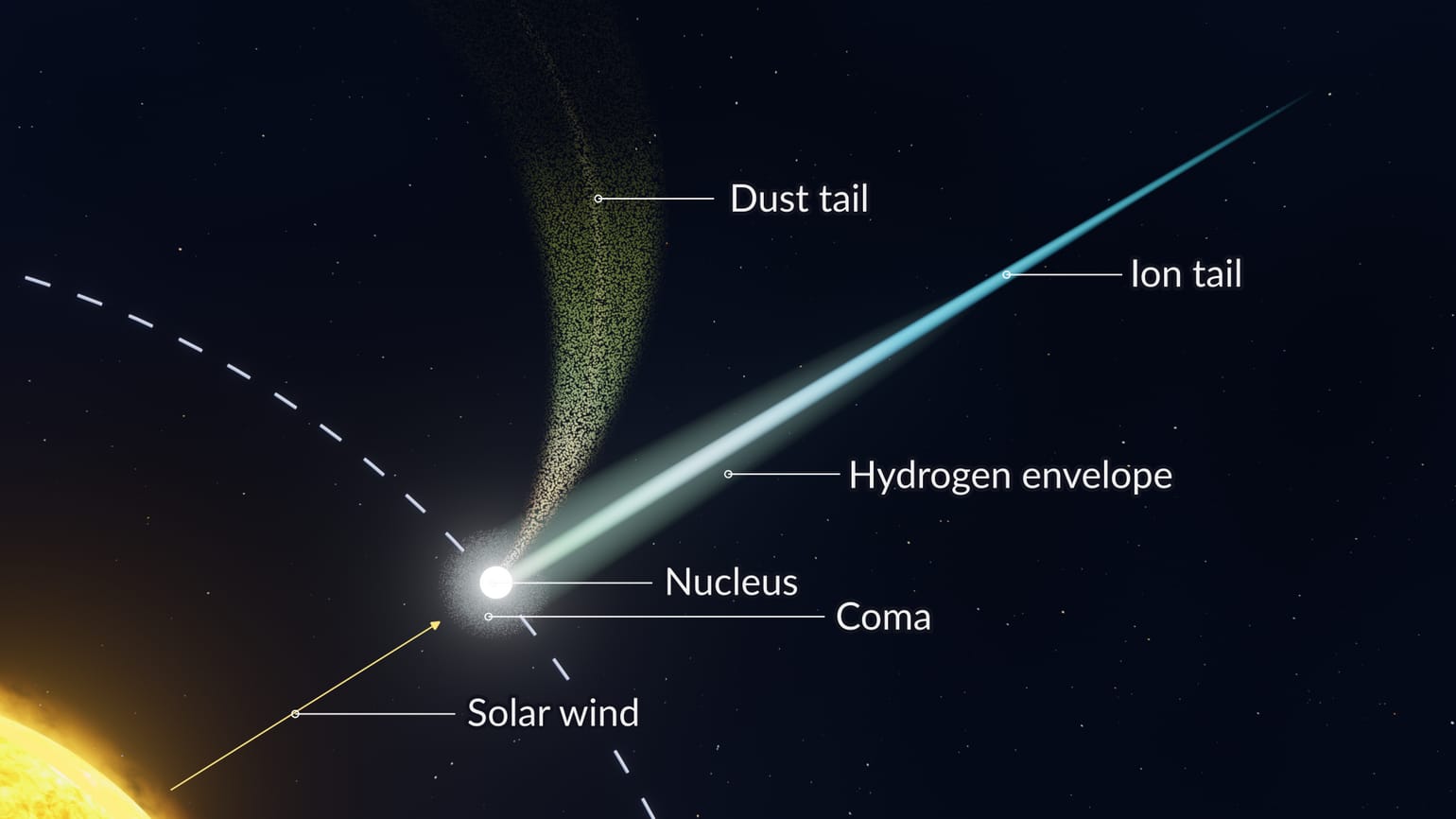
Parts of a comet
Credit: Starwalk
Ancient Time Capsules
Comets are not just pretty objects to look at; scientists consider them time capsules from the early solar system. They were formed about 4.6 billion years ago, around the same time as the planets. Since they have remained frozen all this time, they still hold the original materials from the time when the solar system was young. Studying them gives scientists clues about how planets formed and what conditions existed when Earth was still taking shape.
Some scientists also believe that comets may have played an important role in the origin of life on Earth. When Earth was young and still cooling, comets might have crashed into it, bringing along water and simple organic molecules. These ingredients could have helped form oceans and even the basic building blocks of life. So, comets are not just beautiful visitors in the sky, they may have helped make Earth the living planet we know today.
The Intruder: 3I-ATLAS
But every so often, an object arrives that is not just from our solar neighbourhood, but from beyond it. Quite recently, there have been reports of an interstellar comet, called 3I-ATLAS. It is the third confirmed object to originate outside the solar system, following 1I/ʻOumuamua (2017) and 2I/Borisov (2019).
3I-ATLAS is not a part of our solar system but has been pulled in by our Sun’s gravity! We have a celestial visitor in our solar system from outer space!
Understanding the Name
Let us understand why it is called 3I-ATLAS.
The 3I indicates that this object is the third interstellar object to visit our solar system.
'ATLAS' i.e., the 'Asteroid Terrestrial-impact Last Alert System' is the telescope that detected it.
3I/ATLAS was first identified by the ATLAS telescope in Chile on 1 July 2025, with archival observations pushing its detection back to mid-June.
What Makes 3I/ATLAS Extraordinary?
Hyperbolic Trajectory
Instead of closed elliptical orbits typical of solar system comets, it follows a hyperbolic trajectory, meaning it came in from interstellar space, swung by our Sun, and will eventually leave again.
Safe Distance
Its closest approach to Earth is around ~1.8 AU (≈270 million km), meaning it will not come close enough to pose any threat to us.
Unique Chemistry
Spectroscopic studies suggest the presence of large dust grains (~0.1 mm) and a unique abundance ratio of nickel to iron, significantly different from known solar system bodies.
A Strange Tail
The tail does not face away from the Sun! This is very unusual. The reason could be the presence of heavier elements driving the comet on its path.
Scientific Milestone
3I/ATLAS stands as a milestone in modern astronomy: a true interstellar visitor carrying clues from outside our solar system, offering a rare chance to peer into the makeup of distant worlds. As it speeds away, it leaves behind a trail of scientific opportunity and inspiration for our next generation of explorers.
COME MAKE A COMET OF YOUR OWN!
Our space themed fair, Go Cosmo, offers unique astronomy and science based activities! Using basic materials like corn flour, vinegar, mud and water, you can make a realistic comet that you can hold in your hands.
Explore Go Cosmo ActivitiesFascinated by the Cosmos?
Join our Astronomy Club to learn more about interstellar objects, observe the night sky, and participate in hands-on workshops.
Start Your Journey